RTP is a long-run model
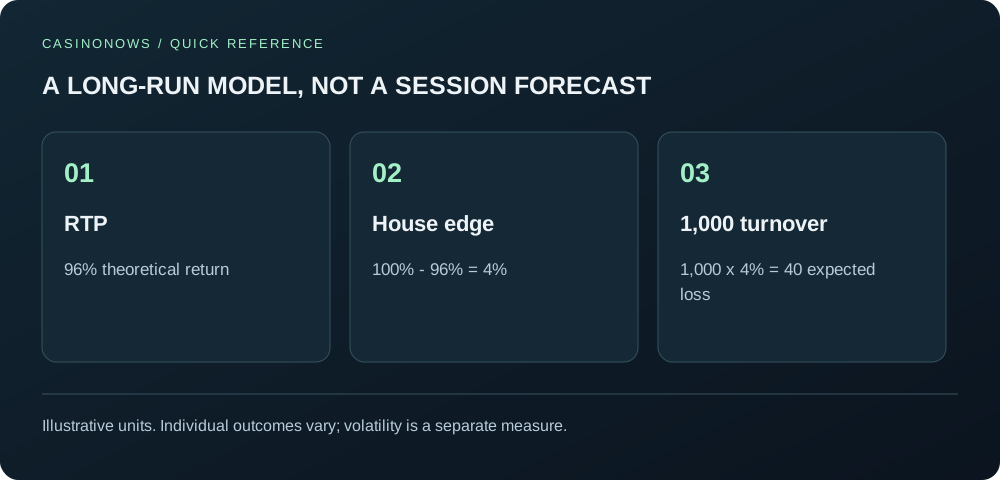
Return to player, or RTP, describes a game's theoretical long-run return under its stated rules. It does not promise what one person will receive in a session. A 96 percent RTP does not mean every 100-unit deposit returns 96 units, and it does not mean the remaining four units are the most you can lose.
The house edge is commonly expressed as 100 percent minus RTP for a game under the relevant assumptions. At 96 percent RTP, that gives a four percent edge. The particular game version and rules matter; a title can be offered in different configurations.
Turnover is different from a deposit
Turnover is the sum of amounts wagered. A player can wager the same money repeatedly, so turnover can be much larger than the original deposit. This is why the mathematical cost of play is linked to wagering volume rather than simply to the amount transferred into an account.
For example, 200 bets of two units produce 400 units of turnover. At a hypothetical four percent house edge, the theoretical average loss associated with that turnover is 16 units. That is a model average, not a forecast of the player's actual result. A particular session can end far above or below it.
The basic calculation
Theoretical average loss equals turnover multiplied by house edge as a decimal. The house edge calculator applies this relationship and shows the implied theoretical return alongside it. It does not simulate a distribution, estimate a probability of ruin or recommend a stake.
A negative result in an actual session does not mean the published RTP must be false. Conversely, winning a session does not mean the house edge has disappeared. A short sample has too much variation to establish either conclusion on its own.
Volatility is a different property
Two games can share a theoretical RTP while distributing outcomes differently. One may return smaller amounts more frequently; another may concentrate more of the return in rare large outcomes. That difference affects the experience and the range of possible short-run results.
RTP alone therefore cannot tell you how long a balance will last or the likelihood of a large loss during a particular session. Those questions require the full payout distribution and a defined pattern of play. A simple calculator should not imply it knows those details.
Game rules and versions matter
Check the return information for the exact game available to your account. Do not copy a percentage from a review of another version or assume every table with a familiar name uses the same rules. Side bets can also have different mathematics from the main wager.
For official background, consult the Gambling Commission's RTP guidance. It is an explanation of the concept, not an endorsement of any operator listed on CasinoNows.
Why bonuses do not erase the model
A bonus can change the funds available under particular conditions, but the turnover required to use it creates exposure to the game's edge and variation. Contribution rules, maximum bets, expiry and cashout caps complicate any attempt to assign it a simple cash value.
Do not subtract a theoretical average loss from a bonus and treat the result as guaranteed profit. The balance may run out, the permitted games may differ, and other conditions can change the outcome. The bonus guide explains those constraints.
Set limits outside the calculation
A mathematical model cannot decide what amount is affordable for a person. Use only an entertainment amount you can afford to lose, avoid borrowing and do not increase stakes to recover previous losses. A losing streak does not make a compensating win due.
If gambling is causing pressure, the appropriate response is support and a pause, not a more elaborate betting calculation. Our responsible gambling page provides independent help routes.