What the phrase actually addresses
Provably fair systems are designed to let a user check aspects of how a game result was generated. A common approach commits to a server seed before play, combines it with other inputs and reveals enough information later to reproduce a result. The details depend on the game and implementation.
This is a claim about a defined process. It is not a certificate that a casino is licensed where you live, financially sound, willing to pay every disputed balance or free from a house edge. Keep those questions separate.
The role of a commitment
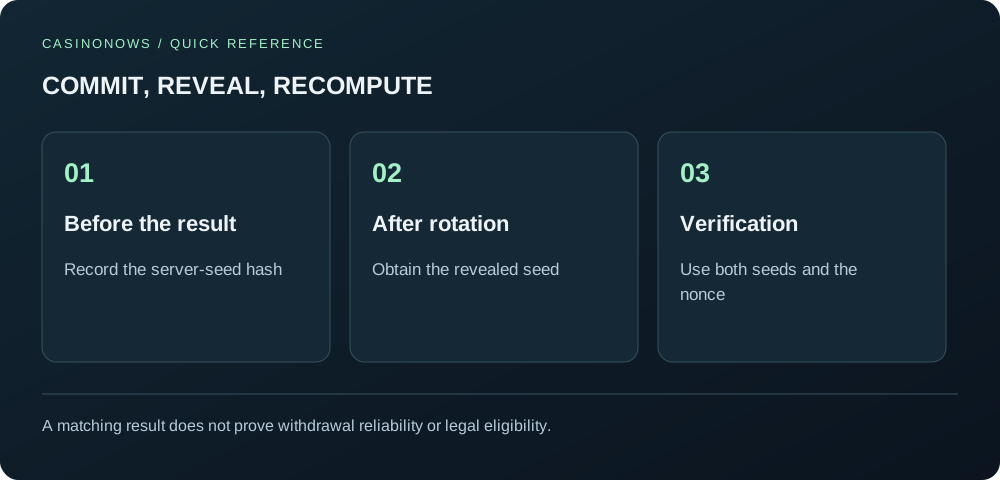
A server-seed hash can act as a commitment to a hidden value. If the revealed seed later produces the same hash, that supports the conclusion that the committed value was not changed afterward, subject to the assumptions of the cryptographic method.
The timing matters. A hash shown only after a result does not provide the same evidence as one recorded beforehand. Save the relevant inputs through the operator's genuine history or verification interface if you want to check a completed round.
Client seed, nonce and outcome mapping
A client seed can add a user-controlled input, while a nonce distinguishes rounds using the same seed pair. The game then maps derived values into an outcome. The exact algorithm, input encoding and mapping matter; different games need not use the same process.
Checking a seed hash alone does not necessarily reproduce the game result. A complete check follows the documented algorithm through to the outcome. Use the version applicable to the round you are investigating rather than assuming a generic verifier works for every game.
A verification sequence
Record the commitment and the relevant game information. After the seed is revealed, hash it according to the documented method and compare it with the earlier commitment. Then use the client input, nonce and published mapping to reproduce the result, where the system provides those details.
Duelbits publishes a worked verification example. It is an operator example, not a CasinoNows account test. We link it as a concrete explanation of the process rather than claiming we played the cited round.
Fairness does not remove the house edge
A random process can be correctly implemented while paying less than fair mathematical odds. A game can therefore be verifiable and still have a negative expected return for the player. Verification and profitability are different questions.
Our RTP guide explains the long-run arithmetic. No seed selection method described here predicts a future outcome or turns a house-edge game into dependable income. Avoid anyone selling a guaranteed predictor based on the fairness label.
It may not cover the whole catalogue
An operator's originals may use a documented cryptographic system while third-party slots or live dealer games use different methods. A review should identify which games a fairness claim concerns. Applying the phrase to an entire lobby without checking would be misleading.
For a particular game, examine its own rules, testing information and verification facilities. If the documentation is incomplete, describe the gap rather than awarding a blanket trust badge.
What remains outside the check
A successful result reproduction does not answer questions about custody, account eligibility, privacy, bonus rules or complaint handling. Those require account terms, regulatory information and, where available, separate evidence about actual service performance.
Use fairness verification as one narrowly defined part of a comparison. The how-to-choose guide places it alongside the other questions that matter before deciding whether to use any casino.