Account and payment terms
Asset: the cryptocurrency or token being transferred, such as BTC or USDT. Its name does not specify every supported network.
Network: the blockchain route used for a transaction. The sending and receiving instructions must match.
Native asset: a blockchain's own asset, such as ETH on Ethereum or SOL on Solana. Other tokens may use the same network.
Wrapped or bridged token: a representation of an asset on another system or through another mechanism. Support for the original does not prove support for the representation.
Transaction hash: an identifier used to locate a blockchain transaction. It is different from an operator's internal withdrawal-request number.
Confirmation: evidence that a transaction has been included in a chain's history. A receiving service can require a particular depth before crediting.
Destination tag or memo: an additional identifier some receiving services require to attribute a transfer to an account. Omitting it can prevent automatic crediting.
Custody: control over assets or the credentials needed to move them. A casino account balance and a wallet you control have different custody arrangements.
Display currency: the unit used to show a balance on screen. It may differ from the underlying account denomination.
Internal balance: the accounting unit used by the operator. A crypto-funded account may still use a fiat-linked internal unit.
Bonus terms
Deposit match: a promotion that credits value based on an eligible deposit, subject to its conditions.
Wagering base: the amount to which a rollover multiplier applies. It may be the bonus, deposit plus bonus, or another defined amount.
Wagering requirement: the qualifying turnover needed to meet an offer's condition. It is not a guaranteed loss or a promise of withdrawal.
Contribution: the percentage of a wager counted toward a requirement. A permitted game contributing 10 percent produces one unit of qualifying turnover from ten units wagered.
Maximum bet: a limit on an eligible stake while an offer is active. Exceeding it may breach the terms.
Cashout cap: a ceiling on withdrawals or winnings associated with a promotion, as defined by the offer.
Free-spin value: the stake assigned to each promotional spin. The spin count alone does not state the total nominal stake value.
Cashback: a reward calculated from a defined measure of activity or losses. Read the base, period, cap and attached restrictions.
Game mathematics
RTP: theoretical return to player over a long-run model. It is not a prediction for a session.
House edge: the operator's theoretical advantage under the specified rules, often expressed as 100 percent minus RTP.
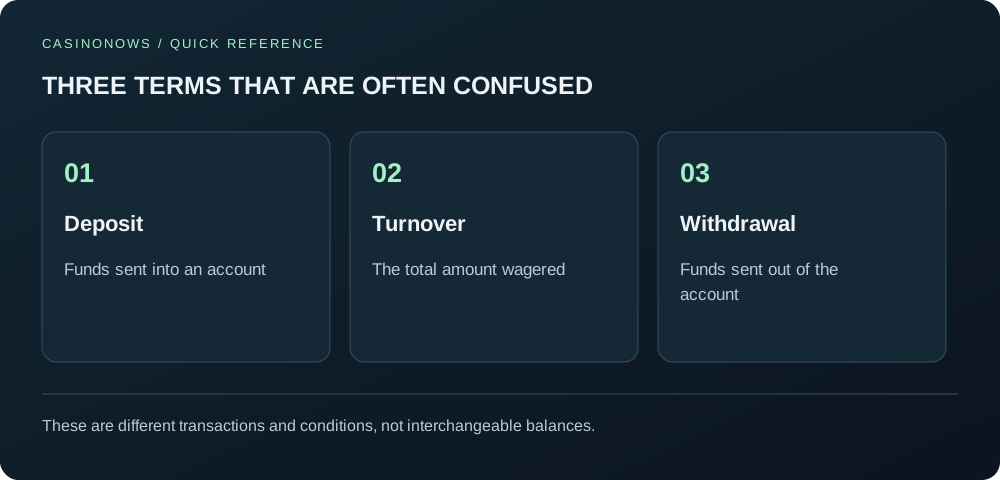
Turnover: total amounts wagered, including money wagered repeatedly. It can exceed the amount deposited.
Volatility: the variation in outcomes. Two games can share an RTP while distributing wins very differently.
Provably fair: a description of a verification system for aspects of game-result generation. It does not certify an entire operator or remove the house edge.
Server seed: a value used by an operator's fairness mechanism. A commitment may be published before the underlying value is revealed.
Client seed: a user-side input in some fairness systems. Its role depends on the documented algorithm.
Nonce: a value used to distinguish rounds or operations within a cryptographic process.
Verification and publishing
KYC: know-your-customer checks used to establish identity and related account information. Email confirmation alone is not necessarily full KYC.
Source of funds: information about where money used in an account came from. It differs from simply proving control of a wallet.
Self-exclusion: a process intended to block gambling access for a defined scope or period. Its coverage should be checked with the provider.
Affiliate link: a commercial referral link that can generate commission for the publisher. It does not prove an offer is available or an operator is suitable.
Canonical URL: the preferred address for a web page. It is a publishing concept, not a casino trust indicator.
For worked examples, use the bonus guide, RTP guide and payment guides. Definitions help decode a condition; the full current terms still determine how it applies.